Nitrogen Cycle
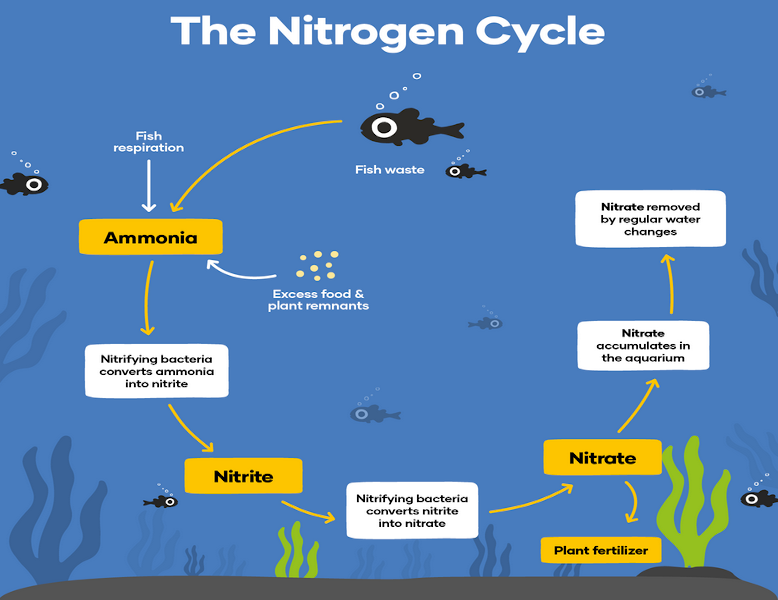
The nitrogen cycle is the natural process in your aquarium that converts toxic substances like ammonia and nitrite into nitrate which is much less harmful for fish and can be beneficial for plants. Fish excrete and eliminate through digestion, excess food rots, plants slough off dead, rotting material, and all of that waste produces ammonia (NH3) which is toxic to aquatic life (0.25 ppm and above).
Nature intervenes via good bacteria (ammonia-oxidizing bacteria, Nitrosomonas or Nitrosococcus) that build up on aquarium surfaces and filter materials and feed on ammonia and convert it into less harmful nitrite (NO2). Nitrites are still toxic (0.25 ppm and above), but other bacteria (nitrite-oxidizing bacteria, Nitrobacter or Nitrospira) feed on the nitrite and covert it into nitrate (NO3) which can also be harmful to fish. Note that no bacteria converts nitrate to anything less toxic. Still, plants use it, and it can be controlled to safe levels via periodic water changes.
Once established the ammonia to nitrate bacteria cycle serves as a filter for maintaining healthy conditions for both fish and plants. These bacteria are beneficial and need proper care.
Cycling for a New Tank Start
- Cycling is the process of initiating and regulating the nitrogen cycle
- Ammonia is the beginning point of the cycle (toxic at 0.25 ppm) (2-3 ppm needed to start cycle)
- Getting beneficial bacteria started, prior to adding fish
- Ammonia (2-3 ppm needed to start cycle) is needed in the tank to give the bacteria something to feed on and grow
- Commercial products like Fritz Fishless Fuel can be added to the water (not when fish are present--toxic to fish)
- Alternatively, introduce small amounts of fish food to the tank without fish present, food rots and produces ammonia
- Exercise patience, 2-4 weeks or more, testing water parameters every few days, especially for ammonia, nitrite, and nitrate levels
- The cycle is complete when testing detects the absence of ammonia and nitrite, and the presence of nitrate
- The process can be accelerated with commercial products like API Quick Start or Fritz Live Nitrifying Bacteria
- Add aquatic life, building up the bio-load gradually, add snails, then plants, then fish, then shrimp, etc
- Nitrate is still toxic to most aquatic animals, but much less toxic than ammonia and nitrite
- Generally, nitrate level should be kept below 50 ppm, ideally 20 to 40 ppm
- Nitrate level can be lowered by water changes and by introducing plants that feed on nitrate by absorption
- Note that dark start cycling is a simple method that circumvents a number of problems associated with traditional cycling methods
Fastest Cycling Method is Seeding (also easiest and most efficient)
- Seeding consists of adding items from an already established aquarium
- Filter media (eg., ceramic rings, floss), substrate, rocks, plants
- Such items contain living colonies of beneficial bacteria
- Nitrifying bacteria form colonies living on the surfaces of items within an aquarium, not so much in the water column
- Once these items are in the new tank, the new aquarium has a substantial head start in building up a healthy nitrogen cycle
- Almost immediately, the new tank is able to convert ammonia to nitrite, and nitrite to nitrate, but it still takes some time to build up
- Still, the cycling period can be reduced from several weeks to just several days
- Plants can be introduced within a few days to begin consuming the nitrates, taking advantage of the functioning nitrogen cycle
Keeping the Beneficial Bacteria Healthy (and Tank Healthy)
- Aerobic -- these bacteria need oxygen, so good water flow and surface agitation are helpful, supply aeration via air stone
- Colony Growth -- bacteria colonies take time to develop (weeks), new cycle slowly, add fish gradually
- Location of Colonies -- these bacteria do not typically float in the water column, but are surface-clinging and stick to filter media, gravel, rocks, driftwood, and plants within a matrix called biofilm.
- Do Not Over-clean -- Avoid sterilizing filter media or substrate or rocks or driftwood as that disrupts bacteria colony
- pH Stability -- Slightly alkaline water is best (pH 7.0-8.5), neutral pH is good. Bacteria health suffers if pH drops below 6.5
- Temperature -- Optimal growth occurs between 68F and 82F
Cloudy Water
- Usually due to a temporary bloom of nitrifying bacteria caused by an upset of the nitrogen cycle balance
- Cleaning the tank or a filter can upset the biological filter by removing a significant amount of the bacteria responsible for driving the nitrogen cycle
- With massive trimming, when a lot of the plant mass is trimmed at the same time, a lot of plant tissue is damaged all at once, and the bacteria suddenly have more work to do
- These conditions can spark a temporary bacteria bloom, as the bacteria respond to meet the new demands
- Give the tank a few days to re-establish the biological filter balance, and the water will again become clear
- Test water for ammonia or nitrite spike, do water change if necessary, use API Quick Start to assist bacteria cycle restart
- Cloudy water with green tint usually caused by a free-floating algae, phytoplankton, bloom
- Triggered by
- Excessive lighting, high nutrient levels (nitrates/phosphates)
- Massive trimming, reducing plant consumption of nutrients, provides excess nutrients for planktonic algae
- While unsightly, generally not harmful to aquatic life
- Getting rid of the algae bloom
- Reduce lighting
- Perform water changes to reduce nutrient levels
- Avoid overfeeding livestock to reduce nitrate level
- If regularly dosing fertilizer, remember to cut back for a few days after trimming plants (less plants = less nutrient consumption)
- Avoid massive trimming, opting instead to trim lesser amounts more often