Controlling Algae
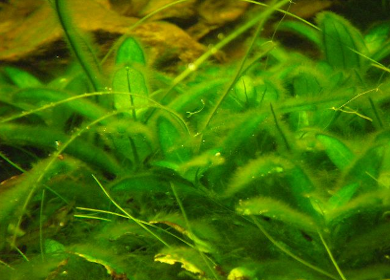
Algae control basically depends on the right balance of light, CO2, and nutrients. Light photo period of 6 to 8 hours per day, monitor CO2 with drop checker, and test for nutrient levels including phosphate (nitrate level can be a good indicator). Exercise restraint with fertilizer, use the lean fertilization method. Give plants only the nutrients they need so there's not enough for algae to feed on. Balance can take time, so patience is needed.
What is algae
- Algae are not considered true plants, but rather plant-like organisms that photosynthesize like plants
- Algae are a diverse aquatic group ranging from microscopic unicellular organisms to complex multicellular organisms
- Algae consumes waste (nutrients) and CO2, releases oxygen during photo period, consumes oxygen at night same as any plant
- Algae does about everything a plant does, and very efficiently, eg., can exist with less light
- Algae itself is a good thing, food for fish, snails, shrimp, helps keep water clean
- Algae is present in all mature aquariums to some degree
- It's a natural part of the ecosystem, usually residing in the biofilm
- The problem is that under certain conditions it can become excessive and unsightly in an aquarium, so it must be controlled
Algae appears when more light or more nutrients or both are available than what plants can actually use
- An aquarium is constantly producing nutrients
- Fish waste, uneaten food, decaying plant matter all break down into nutrients
- At the same time the tank light is constantly providing energy, the amount of light plants receive determines how fast plants try to grow
- Think of light as energy and nutrients as building materials
- When light and nutrients are balanced plants grow healthy and stable
- When light and nutrients are out of balance plants suffer and algae takes advantage
- If lighting is strong but nutrition is poor, plants receive energy to grow fast but not the materials to support growth, so they weaken, grow unhealthy, and start to decay, that decaying plant matter releases more nutrients and those nutrients have fewer good plants to use them, so it becomes fuel for algae
- If lighting is weak but nutrition is abundant, the building materials are there for growth, but the plants are not getting the energy to absorb them, but the over abundance of nutrients is great for algae which needs less light
- So, you can have very strong light and not have algae as long as the nutrition matches that light
- Both factors, light and nutrients are controllable
- Lighting can be adjusted, either intensity or length of photo period
- Nutrition can be adjusted, and in many cases that's the most practical solution
Ideal Conditions for Plants vs. Algae
| Plants | Algae |
|---|---|
| High Light, Low Nutrients, No CO2 | |
| Low Light, Low Nutrients, No CO2 | OR |
| OR | Low Light, High Nutrients, No CO2 |
| High Light, High Nutrients, High CO2 | OR |
| High light, High Nutrients, No CO2 |
Reduce liquid fertilizer or root tabs after plant trimming, lower dosage by 25% or skip one dose to keep the light, nutrient, CO2, plant mass all in balance
- Plants need time to adjust after trimming so growth is slowed, need less nutrients
- In addition, plants release their own fertilizer/nutrients (sap/hormones) when trimming
- In short, plants need less fertilizer/nutrients until they recover from the trimming shock and begin growing again
Regular water changes help prevent algae
- New setup, 50% water changes every couple of days for first few weeks, especially with aqua soil
- 25% water changes weekly for established tanks
- Do water change immediately after trimming plants to reduce accumulated nutrients in the water column and to reduce the organics exuded by plants due to vascular cuttings
- Do water changes before or after photo period to keep CO2 and pH equilibrium
General Algae Control Tips
- Maintain consistent photo period--plants get used to daily light schedule, don't confuse them
- Use floating plants that take CO2 from air above water and nutrients from the water column
- Plant a lot of plants from the start to compete with algae for nutrients, fast growing plants help
- Focus on growing healthy plants rather than trying to avoid algae (positive vs negative strategy)
- Have a lot of nutrients in the substrate rather than suspended in the water column, maintain lean fertilization method for the water, algae has to get its nutrients from the water, (low liquid fertilizer)
- During start up weeks, after planting, avoid using liquid fertilizers, give the plants time to adjust to new environment, they are fine without nutrients for a few weeks, especially in presence of aqua soil substrate low nutrients in water column is best
- Use an aquatic clean up crew, snails, shrimp, fish
Four Step System for Diagnosing and Curing Algae Problems
- (1) Eliminate loose variables
- How long is my photo period duration? Light intensity?
- When did I last clean my filter? Is the flow still adequate for keeping the water column clean, keeping nitrates down?
- Are my water parameter test kits still good, too old to be accurate? False readings lead to poor conclusions
- (2) Test water parameters, special attention to ammonia, nitrates, and phosphate
- Any ammonia is a red flag, should register 0, the presence of ammonia alone can explain algae problems, find the cause and fix that first, once ammonia is under control algae should fade within a couple weeks
- Ammonia in the water column indicates that something has overloaded the nitrogen cycle (bacterial filter)
- Deceased fish is a common cause, as well as decaying organic matter, eg., shed leaves, rotting wood, excess fish food
- Excessive stirring of substrate can release trapped waste into the water column faster than bacteria can break it down
- In any event the source of the ammonia presence must be located and eliminated
- A water change can help the system recover
- Next, focus on nitrates, while plants need nitrates as primary nutrient for growth, more nitrates than the plants can consume provide a feast for algae (use nitrate levels 40+ ppm as a limiting indicator)
- Inconsistent water changes can cause excess nitrates, because nitrates continue to build over time, reduce that buildup by replacing water periodically (at least 20% change per week)
- Over feeding can cause excessive nitrates, as well as any other organic waste
- Finally, check for phosphate level, while phosphate is an essential plant nutrient, when the phosphate level exceeds what the good plants can consume, algae will gladly consume the excess and bloom
- Over feeding can cause excessive phosphate buildup, as well as any other organic waste
- Inconsistent water changes can be an issue, but tap water can come with high phosphate levels, so check the source water for water changes
- Elevated phosphate can be controlled with filter media like PhosGuard, but that should be a short-term fix
- If the tap water (aquarium source water) is laden with phosphate, consider water changes with remineralized RODI water
- (3) Identify the algae type, this step comes later in the list because algae problems are usually solved by fixing the basics first (viz., lighting, filtration, maintenance, water quality) without ever needing to identify a specific algae type, but if those steps don't help, then algae type matters
- Not all algae comes from the same cause
- Treating every algae problem the same way can get us stuck in a loop of continuing algae bloom
- Each type of algae points to a different kind of system imbalance
- Some respond to excess light
- Some appear when certain nutrients are missing
- Some thrive in low flow or stagnant areas
- Some result from unstable CO2 or poor circulation of CO2
- Misidentifying algae leads to fixing the wrong thing, the algae keeps coming, and the system can be thrown further out of whack
- The next section helps identify common algae types, how to reduce it and keep it from coming back
- (4) Identify nutrition problems
- Examine overall plant health for clues
- If plants are struggling to grow properly, algae often moves in because algae feeds on same nutrients as plants
- Different algae types point to specific nutrition problems
There are several common types of algae found in freshwater aquariums, including green dust algae, green spot algae, brown algae (diatoms), blue green algae (cyanobacteria), staghorn algae, hair algae (green thread algae), black brush algae, and phytoplankton (planktonic algae).
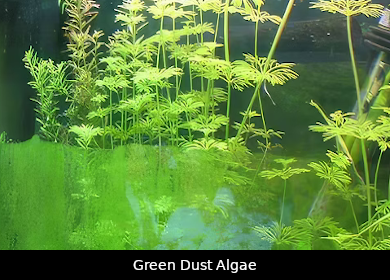
- Looks like green dust, often appearing first on aquarium glass, forming a thin green layer
- Easy to clean it off with algae scraper or scrub pad, but if not dealt with, it can take over entire aquarium
- 5 reasons for green dust algae
- Aquarium is new, new set up, not yet biologically balanced (full nitrate cycle)
- Over dosing liquid fertilizer, especially nitrogen (nitrate)
- Light is too strong (excessive photoperiod or intensity or both)
- Low plant mass competing for the nutrients that algae likes
- Aquarium is dirty, neglected, improved maintenance needed
- Getting rid of green dust algae
- Sponge or brush or algae scraper to clean affected surfaces
- Consider the need to reduce light duration or intensity or both
- Reduce liquid fertilizer, dose only what your good plants can consume within a short period, so there's no nutrients left for the algae (lean fertilization method)
- Increase plant mass (more plants for consuming more of the available nutrients, out competing the algae)
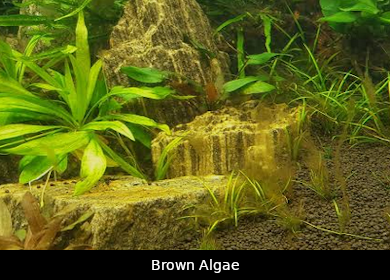
- Brown algae diatoms are single-celled photosynthetic organisms of golden-brown color that layer upon hardscape, substrate, and plants
- 90% of brown algae cases are normal, just a phase for a new aquarium, before beneficial bacteria gets established
- Often pops up in the 3rd to 4th week of a new setup
- Sometimes fostered by silicates which can come from tap water, rocks, or sand
- While phosphate is an important nutrient, in excess it will support brown algae growth (check tap water/source water for elevated phosphate levels
- Getting rid of brown algae
- Recall that it's just a phase and wait it out, let nature run its course
- Clean it up manually, it's not stubborn, comes off hardscape easily with cloth or sponge, but cleaning plants is not practical for us, so we enlist a cleanup crew
- Cleanup Crew consists of shrimp, snails, oticinclus catfish
- What if it doesn't go way?
- 90% of the time it's just a phase that goes away, but what about the 10%?
- High levels of silicates or phosphates can be controlled with filter media like PhosGuard
- If the source water/tap water is laden with phosphate or silicates or both, then consider doing water changes with remineralized RODI water
- Can brown algae be avoided entirely? Yes, do a dark cycling setup, with all hardscape in place, but no fish or plants, then without light, establish the nitrogen cycle
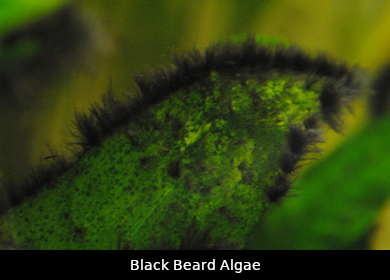
Black Beard Algae or Black Brush Algae (BBA)
- Not a case of too many nutrients, BBA shows up when plants can't use nutrients properly
- Plants need carbon from CO2 to use nutrients
- When CO2 is stable, nutrient uptake happens naturally
- When CO2 is unstable, that process breaks down
- Plant growth slows or pauses
- Unused nutrients stay dissolved in the water column and BBA takes advantage
- Note that CO2 doesn't need to be high, just consistent
- Reasons for BBA developing are usually CO2 related
- Low CO2 levels, high oxygen levels
- CO2 levels are fluctuating, unstable supply
- Aquarium is not balanced yet due to new setup
- Lack of maintenance, tank is dirty
- Nutrient imbalance, high iron or phosphate levels
- Getting rid of black beard algae
- This algae can be very stubborn without the use of chemicals
- Liquid carbon fertilizer, applied directly with a syringe, wait a day after application for results, should turn reddish
- Hydrogen peroxide (3% solution) can also be used, but with great care because it can harm plants if touched, so if using it, drop the water level of the tank and apply it to hardscape objects with a small brush
- If using chemicals is not desired, get a siamese algae eater (but they get large), or clithon snails
- If using chemicals the algae will begin to die off and then other fish and shrimp will eat it
- The best cure is ensuring stable CO2 so that plants resume healthy growth
- How to stop it from coming back
- Determine the root cause and remedy it, or it will keep coming back
- Ensure CO2 levels (30 milligrams per liter) are adequate and stable
- Use CO2 drop checker, use regulator and timer, keep diffuser clean
- Do water changes after the photosynthesis period to prevent disrupting the CO2 plant use
- Check dosage of liquid fertilizer, check phosphate level
- Keep tank clean through routine maintenance
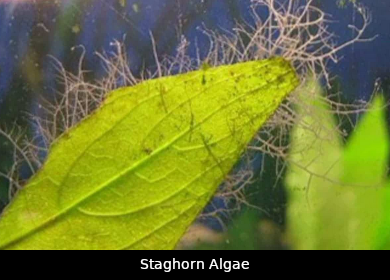
- Triggers for staghorn algae
- Low CO2 levels, keep eye on CO2 drop checker
- Spike in ammonia levels, excess waste organics
- Some aqua soils leach some ammonia, without regular water changes ammonia can build up
- The aquarium nitrogen cycle is not balanced yet
- Poor water flow, CO2 and nutrients are not well distributed, causing dead zones
- Nutrient imbalance, either very high or very low nitrates, or excess iron dissolved in the water column
- Water is too warm, algae likes warm water
- Getting rid of staghorn algae
- Start by removing as much as possible manually, on hardscape use toothbrush to scrub away, on plants remove affected leaves
- Then do a 50% water change to reset nutrient levels and reduce ammonia
- Clean the filter (but preserve the bacteria population), optimize flow
- Possibly increase the CO2 injection, possibly use liquid carbon via a syringe
- How to stop it from coming back
- Optimize CO2 levels, use drop checker
- Keep up maintenance, 25% water change once a week, siphoning up waste organics
- Provide enough nutrients to keep plants healthy
- Liquid fertilizer in proper dosage, every couple of days instead of one big volume weekly
- Lean fertilization method, if plants don't need more nutrients, don't add it
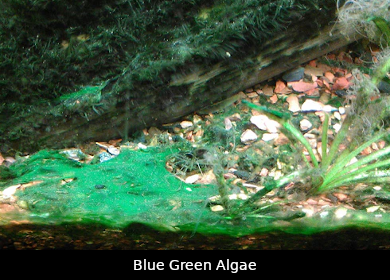
- Blue green algae is not actually algae but cyanobacteria
- Photosynthesizes and grows like plants/algae
- Blue green algae doesn't smell good
- Common reasons blue green algae develops
- BGA appears on substrate when the substrate is tightly compacted with low oxygen exchange
- Low nitrates (eg., low nitrogen fertilization or aqua soil is absorbing nitrate) can foster BGA
- High phosphates--poor maintenance, not enough water changes, excess waste organics can raise phosphate level and trigger BGA
- Getting rid of blue green algae
- Shrimp, fish, snails never touch it
- Black out treatment--harsh, entire tank blocked of light for 4-5 days, this works but there are easier ways
- When blue green algae appears start dosing a nitrogen fertilizer or increase current dosage to 30 ppm for a couple weeks
- If you have dense substrate that doesn't allow much oxygen exposure, like sand, remove the top layer with a gravel vacuum/siphon
- However if you have a densely planted tank this can be quite disruptive
- Or if you have a nutrient rich layer beneath your substrate, using a gravel vacuum could mess it up
- Using antibiotics is possible because it is cyanobacteria, eg., API Erythromycin or Fritz Maracyn
- If caught early one dose may suffice
- After BGA is well established, it may take several doses
- Antibiotics are problematical because they can also kill good bacteria, destroying the biological nitrogen cycle
- How to stop it from coming back
- Keep phosphate level low with good routine maintenance, frequent water changes, removal of waste organics
- Keep nitrate level up around 20 ppm
- Keep water temperature low
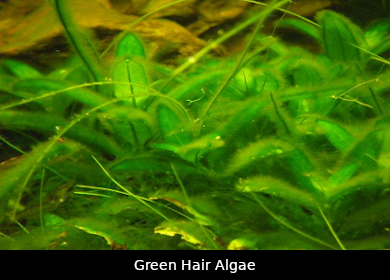
- Green hair algae is sometimes referred to as thread algae or filament algae
- Green hair algae is quite common especially in the early days of getting an aquarium's biological filter balanced
- They can form coats, from which densely packed short filaments grow
- They can also form carpet-like layers, growing over plants and hardscape
- Common reasons why hair algae develops
- In the early days of a tank set up, while still balancing plant to nutrient levels it's normal to see some green hair algae
- With this algae an imbalance of nitrogen is usually the problem, especially in the form of excess nitrates (above 40 ppm)
- Green hair algae is very efficient at using nitrate, even more efficient than desired aquatic plants
- Plant mass is low, not providing enough competition for the nutrients hair algae like, specifically nitrate
- May be over dosing nutrients (especially nitrogen) for the existing plant mass
- Elevated phosphate levels can also hair algae growth
- Overfeeding is a common cause for excess phosphate
- Source water, tap water, may contain high phosphate level
- Often due to not enough CO2 in the water to fuel healthy plant growth
- When sufficient plant mass, nutrients, and CO2 levels are balanced for healthy plant growth, hair algae will disappear, healthy plants always win the competition against algae in a stable system
- Too much light (too long a photoperiod, eg., more than 10 hours) can also trigger hair algae, however usually only when nutrients and CO2 are out of balance (6-8 hours of photo period duration is good)
- Getting rid of green hair algae
- Remove filaments manually with a tube brush, but there will always be some bits and pieces that remain
- Amano shrimp and cherry shrimp eat green hair algae
- Liquid carbon, either spot dose or add it with every fertilizer dose
- Stopping green hair algae from coming back
- Determine the root cause that made it appear in the first place
- Optimize CO2 distribution, use drop checker
- Adjust fertilization dosage as needed
- Adjust lighting duration or intensity as needed
- In the event of high phosphate, use filter media like PhosGuard, or if tap water contains elevated phosphate use remineralized RODI water for water changes
- Liquid carbon, either spot dose or add it with every fertilizer dose
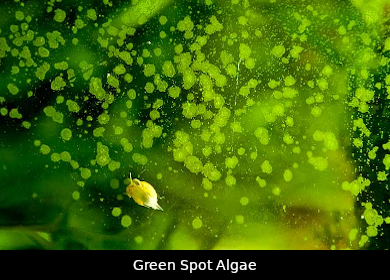
- Small green dots, a millimeter, appearing on aquarium glass and slow growing plants
- Green spot algae is very stubborn, while green dust algae wipes away easily
- Green spot algae often appears around the 4th week of a new setup with rich aqua soil
- Rich aqua soil can cause high levels of phosphate in the water column at first, but after 4 weeks the phosphate level may drop, and that's when green spot algae may appear
- If so, it may be time to start dosing liquid fertilizer with phosphates
- Reason for green spot algae appearing usually has to do with phosphate--either phosphate level is too high or too low, so test for phosphate level, strive for balance
- Getting rid of green spot algae
- If it only appears on aquarium glass, it can easily be removed with an algae scraper
- On hardscape try to brush it off with a toothbrush
- It usually isn't possible to remove from plants without doing harm, try trimming the affected leaves
- For green spot algae on anubias, for example, nerite snails and clithon snails are good at eating it off
- Preventing green spot algae
- Monitor phosphate levels with a phosphate test kit
- Phosphate is an important nutrient for growing plants, but must be held in balance, maintain 0.1 ppm to 0.5 ppm
- In the event of high phosphate, use filter media like PhosGuard, or if tap water contains elevated phosphate use remineralized RODI water for water changes
- Do regular water changes, at least 25% per week
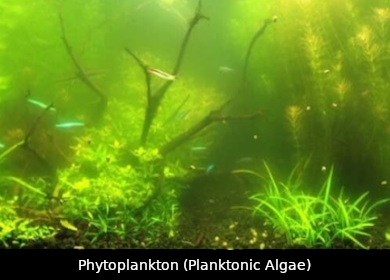
Phytoplankton (planktonic algae)
- Microscopic green floating algae
- Appears as a hazy green or brownish cloud in the water, a "green water" bloom
- Rapid growth often occurs during the initial cycling period
- Typically appears when high nutrient levels, and excessive light duration and intensity conditions are met
- Causes include:
- Overfeeding, unseen dead fish, excessive fertilizer, failure to perform regular water changes, leading to high nitrate accumulation
- Phosphate is a primary limiting factor for algae, and elevated phosphate acts as a catalyst for algae blooms
- Excessive lighting (intensity or duration or both) or exposure to direct sunlight, triggering rapid photosynthesis
- Trimming aquatic plants heavily can lead to planktonic algae bloom
- Getting rid of phytoplankton
- Determine the root cause and adjust accordingly, or it will come back
- Blackout the aquarium for a few days to deprive the planktonic algae of light energy for photosynthesis
- Or run a UV sterilizer for a few days to kill the phytoplankton
- Test for phosphate level in tank and source water and, if excessive, reduce it
- Use filter media like PhosGuard to bind phosphate
- Use remineralized RODI water to avoid adding more phosphate from source water
- Or use API AlgaeFix for a few days, along with API AccuClear
- Preventing phytoplankton
- Avoid overfeeding, remove any rotting corpse or plant detritus
- Consider adjusting fertilization dose and lighting intensity or duration
- Trim plants frequently in small amounts
- Avoid the removal of large portions of plant mass at one time
- if a massive trim is necessary, decrease fertilizer dosage to match the lower consumption of the remaining plants
- Do regular weekly 25% water changes, always after trimming
- If source water has elevated phosphate levels, use filter media like Phosguard to reduce it
- Note: Use remineralized RODI water to avoid adding more phosphate from source water
Remember that algae can be a good thing for an aquarium
- Small amounts of algae act as a natural, beneficial part of the ecosystem, producing oxygen, consuming excess nitrates, and providing food for tank inhabitants like fish, snails, and shrimp
- In excess algae becomes unsightly, so it must be controlled
- The process of balancing the aquarium ecosystem to control algae promotes good health for plants and animal life