Plant Trimming
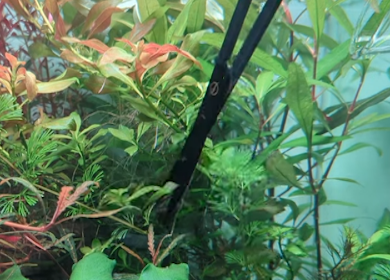
Healthy aquarium plant trimming involves using aquascaping scissors for overall aesthetics and to promote bushy growth, and remove decaying or algae-covered leaves. Begin trimming new plants about 3 to 5 weeks after planting. Thereafter, trim often in small amounts to prevent overgrowth, improve light penetration, even to plants at the substrate level, and to maintain or improve density. Plants respond well to trimming, coming back with fresh, vibrant, compact growth. After trimming remove floating plant debris, replant healthy cuttings for propagation, and perform a water change.
Begin by siphoning off some water to prevent spilling over the sides of the tank while trimming, first step of subsequent water change.
Trimming according to plant types:
- Stem plants (e.g., Pogostemon Stellatus, Rotala)
- For greater density, locate the node (the point where leaves meet the stem), and cut just above a node to encourage two new stems to grow from the single cut point
- Pick off the longest individual stems to keep the bush tidy
- Cut top portions (head cuttings) should be stripped of lower leaves and replanted in the substrate to create denser groups
- Remove old bottoms when the lower stem becomes thick or leafless, pull it out and replace with a fresh, young top
- Remove waste with a net, scooping out all loose trimmings to prevent decay
- Carpeting plants (eg., Monte Carlo, Hairgrass)
- Trim frequently to prevent them from growing too high or detaching
- Cut horizontally, keeping the carpet low and dense
- Trim aggressively, close to the substrate as this forces the plant to spread horizontally rather than growing tall and potentially creating a thick, dead layer underneath
- Trim whenever the carpet gets too thick or high or looks messy, every few weeks or every couple of months
- Replant the trimmings of plants like Monte Carlo or Pearlweed to replant gaps, allowing them to root and fill in the carpet
- Remove floating clippings to prevent them from rotting and degrading water quality
- Rhizome plants (eg., Anubia, Java Fern)
- Identify the rhizome, the thick green stem-like structure that connects roots and leaves
- Trim old, damaged, or algae-covered leaves as close to the rhizome as possible
- Trim long, unruly roots to improve appearance, will not hurt the plant
- If the rhizome becomes soft, brown, or black, cut off the rotting portion immediately to save the healthy plant
- To propagate, cut the green rhizome into sections, ensuring each piece has at least 3 to 4 leaves, then attach them to hardscape with thread or glue
- To replant, do not bury the rhizome in substrate, as it will cause it to rot, instead attach to hardscape with thread or glue
- Rhizome plants grow slowly, so they require less frequent trimming than stem plants
- Rosette plants (eg., Amazon Swords, Cryptocoryne)
- Focus on removing yellow, damaged, or algae-covered leaves from the outer edges to help the plant redirect energy to new, healthy growth
- Avoid cutting through the leaves themselves; instead, remove the entire leaf at the base to encourage new, compact growth and prevent rotting
- Cut at the base, close to the substrate and cut the leaf stem near the crown
- Do not trim middle leaves, the young, small leaves emerging from the center of the crown
- Propagation: If the plant has grown large with many stems (eg., Crypts), pull it out, pull apart the runners, and replant smaller sections
- Trim during routine maintenance, about once per month, to maintain shape
- Cryptocoryne species can melt (lose leaves) when heavily trimmed or moved, but will grow back from the roots
- Remove all severed leaves from the tank to prevent them from rotting and polluting the water
- Stolon plants (eg., Dwarf Sagittaria, Hairgrass)
- Cut the connecting horizontal stems (stolons, runners connecting baby plants to the mother plant) to manage spread, or cut vertical shoots to maintain carpet height
- Thin them out by cutting away older, damaged, or densely crowded leaves to prevent rot and allow light to reach lower part
- For plants like Hairgrass (Eleocharis), you can simply shear the carpet at a set height, while for creeping plants like Monte Carlo, you should cut away overgrown, thick areas to prevent them from floating up
- If a patch is too dense, pull up a portion and use long tweezers to replant small bunches to create a cleaner look
- Most stolon plants can be trimmed severely and will regrow thicker
- Thin them frequently to prevent the lower portions from turning yellow and dying due to lack of light
- Use a net to remove all cut pieces to prevent them from rotting and fouling the water
- Moss plants (eg., Java Moss, Christmas Moss)
- In general, cut the moss into a desired compact shape, allowing it to grow back thicker
- Trim just before water changes, turning off filtration and water flow to prevent floating pieces from spreading
- Use a siphon while cutting to immediately collect trimmings
- Thinning for thick carpeting effect, use fingers or tweezers to pull out chunks which helps it grow back thicker
- Trim every couple of months or as needed for shaping
- Trim aggressively, moss is hardy and will grow back, often more lush
- After trimming and siphoning, use a net to catch any remaining floating particles to keep them from rooting in new places
General Trimming Rules:
- Avoid massive trimming, removing large portions of plant mass at one time, instead perform small trims frequently
- Practice proper trimming with frequent, light pruning that promotes healthy plant growth, as opposed to heavy, infrequent cutting
- Trimming stems forces the plant to split into two, increasing density and bushiness
- It keeps the top from shading the bottom, which prevents lower leaves from dying
- Small, frequent trims are less stressful to the plant ecosystem compared to removing large amounts at once
- It keeps plants from obstructing water flow and ensures light hits all parts of the plant, helping to prevent algae
- Heavy trimming invites algae to take hold, especially phytoplankton (planktonic algae)
- Plants and algae compete for the same nutrients
- A dense, healthy plant population acts as a natural filter and competitor, inhibiting algae growth
- When large amounts of plants are removed, there is less demand for the nutrients, leaving a surplus that fuels phytoplankton
- When trimmed, plants exude sap and hormones from damaged tissues that temporarily affect water quality or nutrient levels
- Positive, the sap and hormones act as a trigger to stimulate new growth, allowing stem plants to branch out bushier
- Negative, the sap and hormones increase nutrient levels in the water column further fueling planktonic algae growth
- Large-scale removal of plants can increase light penetration, favoring algae growth
- If a massive trim is necessary, decrease fertilizer dose to match the lower consumption rate of the remaining plants
- Replant the cut stems immediately to maintain high nutrient uptake
- Significant water change (e.g., 50%) is needed after heavy trimming to reduce any released organics and keep the water clear
- Clean up plant cuttings, trimmed plant debris left in the water can decompose, releasing more nutrients that boost algae growth
- After trimming, perform a water change to reduce released organics and keep the water clear