Phosphorus Cycle
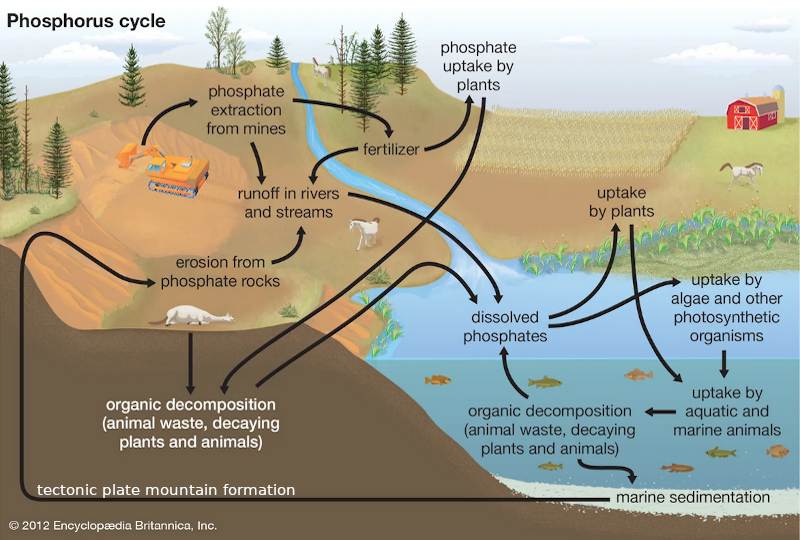
The phosphorus cycle is the slow, biogeochemical process that moves phosphorus through the lithosphere (rocks/soil), hydrosphere (water), and biosphere (living organisms). It is crucial for life. Phosphorus is found in DNA, RNA, ATP, and cell membranes, but the cycle does not involve the atmosphere, making it a sedimentary cycle. This cycle is important for aquariums because phosphorus and its common form of phosphates are among the most important nutrients in the world for all living things. Every living organism has phosphorus/phosphate within its cells. Curiously, phosphorus comes naturally locked in stones and rocks, and cannot be used in that form. Understanding the phosphorus cycle explains how phosphorus gets from being locked away in stone to being in every cell of every living organism.
Key Stages of the Phosphorus Cycle
- Weathering and Erosion
- Phosphorus begins primarily in sedimentary rocks in the form of phosphate (PO4) ions
- Rain and chemical weathering slowly break down these rocks, releasing phosphates into the soil and water
- Biological Uptake
- Plants absorb dissolved inorganic phosphates from the soil and water through their roots
- These phosphates are used to build essential biological (organic) molecules like DNA, RNA, and ATP
- The phosphates are then passed to animals when they consume plants
- Consumption
- Phosphorus moves through the food chain when herbivores eat plants and carnivores eat those herbivores
- The phosphorus is used by animals to form structural elements like teeth, bones, and cell membranes
- It is also used to manage energy metabolism through ATP, and create genetic material (DNA/RNA)
- Animal digestive systems break down plant organic phosphates into inorganic phosphate, which is then absorbed into the bloodstream
- Decomposition and Mineraliztion
- When plants and animals die or excrete waste, decomposers (bacteria and fungi) return organic phosphorus is returned to the soil or water
- Through a process called mineralization, microbes (bacteria) convert organic phosphorus back into inorganic phosphorus for plants to reuse
- Sedimentation and Uplift
- Excess phosphorus eventually washes into rivers and the ocean, where it settles on the river or sea bed as sediment
- Over geologic time, tectonic plates can lift these sediments to form new land and mountains, restarting the cycle
The Phosphorus Cycle is Unique
- No gaseous phase: Unlike nitrogen or carbon, phosphorus does not enter the atmosphere, and remains almost entirely in rocks, soil, water, and living tissue
- Extremely Slow Cycle: One of the slowest bigeochemical cycles, relying on geological processes like weathering
- Limiting Nutrient: Because it is often scarce and insoluble in water, phosphorus is frequently the limiting factor for plant growth in both terrestrial and aquatic ecosystems
Why the Phosphate Cycle Matters
- Limiting Factor: Because it is releaased so slowly from rocks, phosphorus is often the limiting nutrient that restricts the plant growth of ecosystems
- Human Impact: Humans accelerate the cycle through phosphate mining, the extensive use of fertilizers (runoff), industrial wastewater, sewage
- Eutrophication
- The over-enrichment of water bodies (streams, rivers, lakes, coastal waters) with nutrients, primarily nitrogen and phosphorus
- This over-enrichment leads to excessive algae growth
- Ultimately, the algae die and are decomposed by bacteria which consume oxygen, leading to low-oxygen "dead zones" that destroy aquatic life
- This process can occur naturally over centuries but is rapidly accelerated by human activites
- Eutrophication in Aquariums
- Over-enrichment of water with nutrients, primarily nitrogen and phosphorus, leading to excessive algae growth
- Causes include overfeeding, excessive fertilizers, neglected maintenance, and tap water (source water) laden with phosphates
- Left unchecked, algae outbreaks support excess bacterial growth, oxygen depletion, leading to stress for all aquatic life
- Controlling Elevated Phosphorus/Phosphate levels in Aquariums
- Focus on a combination of source water management, regular maintenance, and chemical filtration
- Elevated phosphate levels (unless extreme) are rarely toxic to fish, shrimp, snails, etc
- Elevated phosphate levels are a primary driver for nuisance algae blooms
- Brown (Diatom) Algae
- Green Hair Algae
- Green Spot Algae
- Phytoplankton (Green Water Algae)
- Other common algae types
- Strategic Controls
- Test Source Water
- Tap water sources often contain high levels of phosphates (1 ppm or greater)
- If that is the case, consider using remineralized RODI water for the aquarium
- Manage Feeding: overfeeding is the #1 source of phosphate introduction, choose high quality food with low phosphates
- Increase fast-growing plants that absorb phosphates for growth, competing with algae
- Maintenance Strategies
- Regular Water Changes
- First ensure that source water is not the issue
- Weekly 20% water changes are the most effective way to dilute phosphate levels
- Remove animal waste, uneaten food, and decaying plant matter
- Keep filter media clean with old tank water
- Chemical Filtration
- If strategic remedies and maintenace alone are not enough, specialized filter media can be used
- Products like SeaChem Phosguard are designed to bind and remove phosphates