Lighting
Aquarium lighting is mostly about plants. For fish only tanks ordinary illumination is sufficient for appearance. However, lights for planted aquariums are essential for powering photosynthesis, which allows plants to producew food, grow and convert CO2 into oxygen. Lighting for plants simulates the wavelengths of natural sunlight (particularly those used most for photosynthesis), and helps maintain a healthy, balanced ecosystem by regulating the biological clock for both plants and animals inhabiting the aquarium.
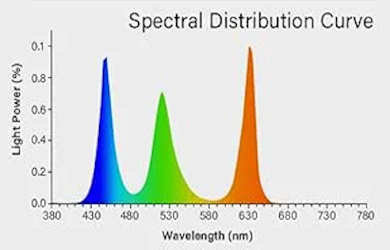
Photosynthesis uses primarily the visible light spectrum, within the 400 to 700 nm range, known as Photosynthetically Active Radiation or PAR.
- Peak usage in the blue (400 to 500 nm) and red (600 to 700 nm) regions
- Key photosynthesis wavelengths and their effects
- Red light (600 to 700 nm): The most efficient wavelengths for driving photosynthesis, strongly absorbed by chlorophyll
- Blue light (400 to 500 nm): Highly absorbed by chlorophyll, critical for driving photosynthesis and promoting chlorophyll production and vegetative growth and leaf development, also regulates CO2 intake through stomata (pores)
- Green light (500 to 600 nm): To a lesser degree does drive photosynthesis, especially in lower leaves of a canopy because it penetrates deeper into leaf tissues than red or blue light
- The absorption spectrum of green leaves shows peaks in blue and red, which is why they appear green, as they reflect green light while absorbing the other colors for energy (though reflecting a lot of green wavelengths, plants do absorb some green light)
Color Temperature Scale measured in Kelvins (K), ranging from 2000K to 10000K, sets the tone of aquascape lighting
- 2500K tp 4500K is warm lighting, brings out the rich reds, oranges, and golds, incandescent lighting is about 4000K
- 5000K to 6500K is bright white, daylight/direct sunlight, sweet spot for freshwater plants, boosting photosynthesis and plant health
- 7000K to 10000K is cool light, like blue sky, mirrors deeper blues of the ocean, ideal environment for marine tanks
Photosynthetically Active Radiation or PAR
- Measures the wavelengths of light that plants actually use for photosynthesis, 400 to 700 nm range
- Includes the shorter purple and blue wavelengths through the longer orange and red wavelengths, crucial for plant health
- Photosynthetic Photon Flux Density (PPFD), measured in micromoles per square meter per second
- Most common unit for measuring PAR, used by growers to measure the light actually reaching the plant surface
- Quantifies the number of photons within the 400 to 700 nm range hitting a specific area every second
- Represents the light usable by plants and corals for photosynthesis, ranging from 0 to over 1000 micromoles per square meter per second
- Common PAR (PPFD) ranges for aquarium plants
- Low light: 10 to 20 micromoles per square meter per second
- Medium light: 20 to 35 micromoles per square meter per second
- High light: 40 to 50+ micromoles per square meter per second
- Think of PAR as the nutritional value of aquarium lighting
- Various plants have differing lighting (PAR) requirements, check the needs of desired plants and provide accordingly
- Some lighting manufacturers provide PAR data, allowing the estimation of light levels at different tank depths
- PAR is not only important for plant health, but also for algae control
- When a planted aquarium receives high Par light, without the needed balance of nutrients and CO2, it's perfect for algae bloom
- To prevent algae bloom the entire plant trinity (light, nutrients, CO2) must be balanced
Lumens measure the brightness of a light
- A typical candle provides 13 lumens, while a 100-watt incandescent bulb provides 1200 lumens
- Using the above measures as a benchmark, you can get a rough idea of the brightness of different lighting based on lumen ratings
- In aquarium lighting most options will range from a few hundred to thousands of lumens
- Brightness is not the only important factor for growing healthy aquatic plants, you also must take into account light spectrum and intensity of the various wavelengths within the spectrum
Every aquarium is a unique world with its own lighting requirements that depend on the plants, livestock, and desired aesthetic
- Low light aquariums
- Plants like java ferns, cryptocoryne, anubias which thrive in shaded areas
- Fish like bettas, tetras, gouramis
- Warm light settings in the 3000K to 5000K range work nicely to enhance the natural tones of both plants and fish
- Low PAR levels are all that's needed for this setup
- High light aquariums
- Plants like Amazon swords, dwarf sagittaria, bucephalandra thrive in moderate light levels
- Fish like guppies, rasboras, mollies
- Daylight spectrum in the 5500K to 6500K range is ideal
- Moderate PAR levels ensure good plant growth while keeping algae in check
- High light aquariums
- Vibrant red plants, lush carpeting plants
- Fish like discus, angel fish
- Needs not just bright light, but the right amount of PAR (eg., PAR level above 120)
- PAR measures how effectively light is used by plants for growth, including how much light in each wavelength
- Again, high PAR value must be balanced with nutrients and CO2 to prevent algae bloom
- High light tanks with red and carpeting plants thrive best under a color temperature in the 6500K to 8000K range
Combating algae relative to lighting, bearing in mind the trinity of light, nutrients, and CO2
- Start by reducing light intensity or duration or adjust light spread
- Ensure tank has adequate CO2 (drop checker) and nutrients to support plant growth (begin fertilization by dosing according to producer directions, if not already doing so)
- Plants must out compete algae by balancing the trinity factors at optimum levels
Dialing in light duration and light intensity and light spread to promote healthy plant growth and crowd out algae
- In general, change only one light variable at a time (duration or intensity or spread) when making adjustments to help identify what works
- Bear in mind that proper nutrition level, dosing fertilizer, is yet another factor to be taken into account)
- Duration of photo period
- Low light tanks (low-tech) without CO2, set duration for 6 to 7 hours of continuous light
- Medium light tanks (mid-tech) using liquid carbon, fertilizer, fast growing plants, set duration for 7 to 8 hours of continuous light
- High light tanks (high-tech) with CO2 and regular nutrient supply, set duration for 8 hours max
- Observe plant health and watch for algae for a couple weeks
- If everything is fine, leave settings alone
- If you want more growth, but plants are stunted, then increase duration by 1/2 hour, wait a week, then if everything is fine, leave settings alone
- If algae is taking hold, then decrease duration by 1/2 hour, wait a week, then if everything is fine, leave settings alone
- Light Intensity, start conservatively, then ramp up as possible for your own unique aquarium
- Low light tanks (low-tech), set intensity for 20% to 40%
- Medium light tanks (mid-tech), set intensity for 40% to 60%
- High light tanks (high-tech), set intensity for 60% to 80%
- Observe plant health and watch for algae for a couple weeks
- If everything is fine, leave settings alone
- If you want more growth, but plants are stunted, then increase intensity by 10%, wait a week, then if everything is fine, leave settings alone
- If algae is taking hold, then decrease intensity by 10%, wait a week, then if everything is fine, leave settings alone
- Light Spread, where is the light mounted above the tank, forward, center, back, close to water or higher up
- Light source should be up high enough off the water to provide light to as much of the tank as possible
- Low light tanks (low-tech), raise light 3 to 4 inches above the water surface
- Medium light tanks (mid-tech), raise light 4 to 6 inches above the water surface
- High light tanks (high-tech), raise light 6 to 7 inches above the water surface
- Light spread can also be affected by mounting the light fixture along the center of the tank, or moved toward the back or up front depending on the needs of the location of certain plants
- Light spread evenly throughout the tank, without weak zones or hot spots, is usually ideal
- If algae becomes an issue, look to see where the algae bloom is strongest and adjust accordingly
- Specific algae and light related remedies
- Brown algae (diatoms): Usually due to new tank, keep light duration at 6 hours per day, increase duration later as diatoms recede
- Medium light tanks (mid-tech), set intensity for 40% to 60%
- Hair algae: Usually due to too much light duration, reduce duration by 1 hour per day, clean algae out, re-evaluate after 7 days
- Black beard (staghorn) algae: Usually due to too much light for the CO2, reduce duration of photo period to 6 hours, wait for algae to subside, then increase duration to 7 or 7.5 hours in tandem with adding more CO2
Remember to make small, incremental adjustments when needed, changing only 1 thing at a time, then wait a week before assessing and adjusting anything else, walk up to a full solution instead of running past it time and again
- Pale, yellowing plants: Try increasing fertilizer dosage, then consider increasing light intensity
- Algae breakouts: Reduce duration of photo period first, then consider reducing light intensity if it doesn't subside
- Slow plant growth but clean glass, increase light intensity by 10%
- New algae, decrease duration by 1 hour
- Front edge algae only, raise the light fixture or move it forward