Photosynthesis
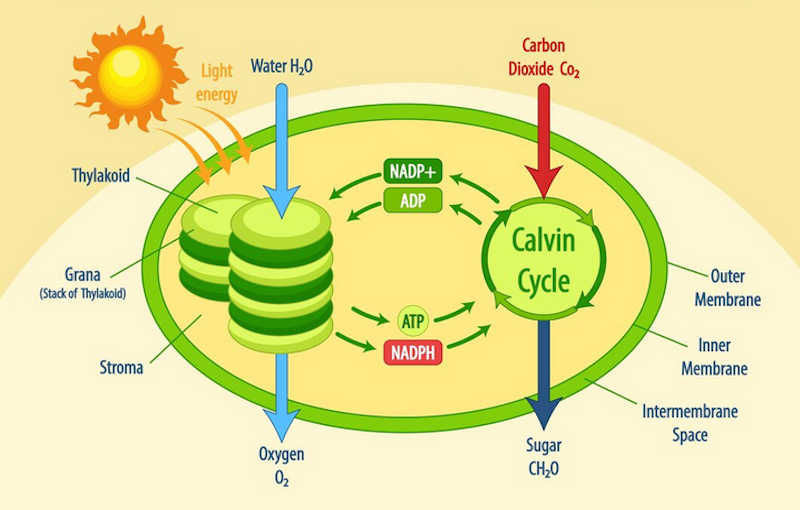
Photosynthesis is the foundational biological process for life on Earth, converting solar energy, CO2, and water into chemical energy (glucose) while releasing oxygen. It sustains nearly all ecosystems by forming the base of the food chain, regulating atmospheric composition by consuming CO2, and providing energy for nearly all living organisms.
Photosynthesis Basics
- Most plants are producers, instead of consuming food to get energy they make their own (except carnivorous plants) via photosynthesis
- During photosynthesis plants take in energy from sunlight and convert it into chemical energy stored in carbohydrates (sugar)
- Plants need three things for photosynthesis
- Carbon Dioxide (CO2)
- Water (H2O)
- Light
- Leaves are the main site for photosynthesis
- Leaves contain chloroplasts in plant cells where photosynthesis occurs
- Chloroplasts contain molecules of chlorophyll that absorb visible light, mainly in red and blue wavelengths, only a few molecules of chlorophyll absorb green wavelengths (plants appear green because they reflect more green light than they absorb)
- Plants use the sugar made during photosynthesis to fuel growth, development, reproduction, and repair
- The simple sugars (monosaccharides) produced in photosynthesis bond to form more complex starches such as cellulose that provide structure to plants
- In addition to providing food source for animals, photosynthesis also removes carbon dioxide from the atmosphere and replenishes oxygen
Two Stages of Photosynthesis: 1) Light Dependent Reactions; 2) Calvin Cycle
- First stage: Light dependent reactions (takes place only during the photo period)
- Involves the absorption of sunlight and the breakdown of water molecules into oxygen gas, hydrogen ions, and electrons
- The goal of this stage is to capture light energy and transfer it to the electrons to make energized molecules such as ATP
- Oxygen is a waste product of this stage of photosynthesis
- How it works
- Plant cells located on epithelial layer of leaves can contain 10s if not a couple hundred small organelles called chloroplasts which are related, through evolution, to cyanobacteria (blue-green algae) which also photosynthesize
- Inside each chloroplast is yet another structure called a thylakoid, another membrane enclosed system that houses all the machinery needed for this first step of photosynthesis
- Embedded within the membrane of the thylakoid are two distinct photosystems that work simultaneously, but with their own agendas
- Both photosystems are protein-pigment complexes that drive light dependent reactions
- PSII (activated first) absorbs light to split water molecules (H2O) into O2, electrons (e-), and protons (H+) through photolysis, releasing oxygen as a byproduct
- PSI (activated second) re-energizes electrons to produce NADPH ( a high energy electron carrier)
- NADPH compound is a high energy electron carrier that stores electrons and hydrogen ions (later in the Calvin Cycle it acts as a reducing agent, working alongside ATP, to convert CO2 into sugars, ei., synthesizing glucose)
- ATP is a primary energy carrier produced during the light dependent reactions to power the Calvin Cycle
- At the end of this process the plant has generated ATP, NADPH, and oxygen from the power of light energy
- The oxygen will be released into the atmosphere, and also shuttled down to the roots to preclude necrosis that would otherwise take place in the anaerobic substrate
- The NADPH and ATP will be used by the plant in the Calvin Cycle where CO2 is converted into sugars and more complex carbohydrates for plant growth and functioning
- Second stage: The Calvin Cycle
- his cycle occurs in three main stages to convert inorganic carbon (CO2) into organic sugar: Carbon fixation, Reduction, and Regeneration
- Taking place in the stroma of the chloroplast, the energized molecules created in the first stage are now used to split carbon dioxide molecules taken in from the plant's environment
- The breakdown of carbon dioxide and water molecules in the plant cell results in the formation of sugar molecules, creating food for the plant
- Specifically, six molecules of carbon dioxide and six molecules of water yield one molecule of glucose (6-carbon), with six molecules of oxygen given off as a by-product
- This non-light-dependent process is essential for producing energy-rich carbon compounds for autotrophs such as plants that do not rely on other organisms for nutrition