Cherry Shrimp
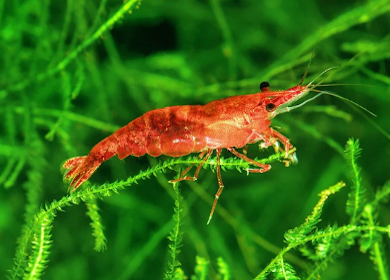
Cherry (Neocaridina) shrimp are hardy and peaceful, freshwater dwarf shrimp ideal for planted community tanks. They help keep the tank clean, thriving on algae, biofilm, and picking up after other fish and plants. Native to eastern China, Taiwan, Korea, and Vietnam, they enjoy rocks and aquatic plants that provide hiding places to keep them feeling secure. They breed easily and frequently, especially in a bed of java moss. Clean, gentle flowing water suits them, and they do well in cool water aquariums. Other colors in the Neocaridina shrimp family include, yellow, orange, blue, black, and various other multi-color hybrids.
- Scientific name: Neocaridina Davidi
- Size: Female mature 1.5 inches, male slightly smaller
- Lifespan: 1.5 to 2 years
- Water parameters:
- pH range: 6.5 to 8.0
- Temperature range: 68F to 77F
- Water hardness: 6 to 10 dGH (107-179 ppm), 2 to 8 dKH (36-143 ppm)
- Stability, consistency more important than chasing any "perfect" numbers
- Diet: Omnivorous scavengers (detritivores), algae, algae wafers, plant detritus, biofilm, flake food, "bug bites", "snowflakes", frozen brine shrimp, daphnia, blanched vegetables (eg., spinach leaf, zucchini), small pieces of shrimp, nocturnal
- Breeding: Easy to breed, requiring few specific parameters, cross-breeding of colors tends toward natural brown color outcomes
- Temperament: Peaceful, work well in community, ei., with small peaceful fish and other shrimp
- Molting: Shedding of exoskeleton to accommodate growth, molting every 3 to 4 weeks or so, after molting shrimp is soft and vulnerable and retreat to hiding spots while new exoskeleton hardens, leave the molt in the tank as a rich source of calcium for feeding
- Water flow: Coming from moving waters, they like gentle yet thorough water flow, well oxygenated but not turbulent
- Filtration: They like clean water with proper balance of nutrients, oxygen, CO2, moderate light, like most aquatic plants, weekly 25% water changes, monitor water conditions regularly
Neocaridina Davidi
Neocaridina Davidi External Anatomy
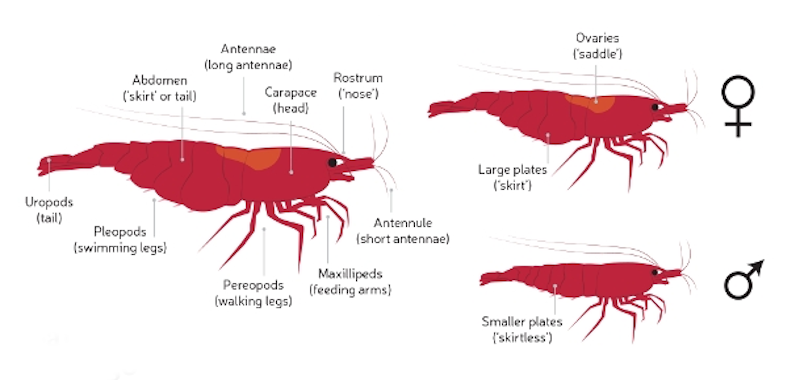
Neocaridina shrimp are invertebrate animals in the phylum Arthropoda, subphylum Crustacea, known for their distinctive hard, chitinous exoskeletons, segmented bodies, two pairs of antennae, paired jointed appendages, and respiration via gills.
Exoskeleton
- As invertebrates, shrimp do not have bones (spine) or any internal skeleton, instead the body is covered with an exoskeleton
- The exoskelton is formed of chitin, a polysaccharide, which acts as an organic, fibrous framework into which calcium minerals become embedded during biomineralization
- Chitin is flexible and tough
- Calcium carbonate is very hard, but brittle
- With calcium carbonate embedding in the chitin matrix, the resulting material is stiff and hard, yet resistant to breaking upon impact
- The exoskeleton or shell, then, is a rigid and durable biocomposite that protects against predators and prevents water loss
- As shrimp grow, they undergo molting, shedding their shells to form new, larger ones
Neocaridina Davidi External Anatomy Detail
Body Structure
- Shrimp bodies are segmented into two main regions, the cephalothorax and the abdomen
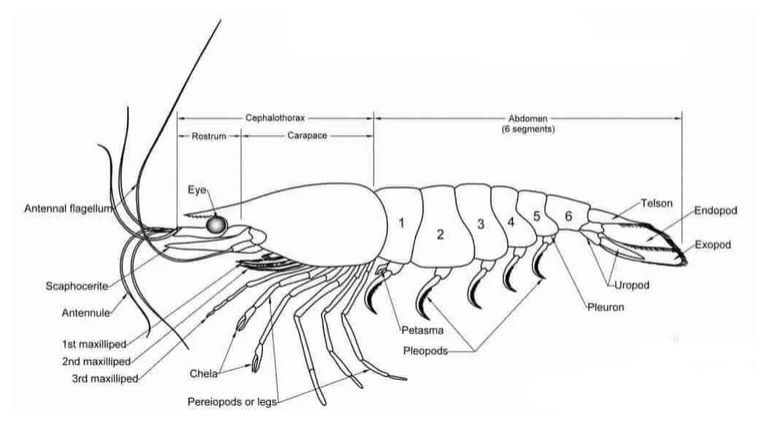
- The cephalothorax is a fusion of the carapace/rostrum [beak-head] and thorax; it consists of
- Carapace, upper body, heavily calcified, protection of the inner organs (brain, heart, stomach, bladder, testicular or ovarian)
- Rostrum, beak or nose, hard extension of the carapace, protection of the eyes, stabilizer when swimming backwards
- Eyes, located on short, independently movable eyestalks either side of the rostrum
- Compound eyes give shrimp panoramic vision, good at detecting movement, important for shrimp at lower end of the food chain
- Eyes also produce the hormones which regulate metabolism, the molting process, location of pigment in the cells, and accumulation of calcium in the body
- Shrimp can regenerate lost limbs with every molting process, but the eyes cannot be regenerated
- Antennae, long whiskers, sensors of orientation and coordination of positioning, detect vibrations in water around the shrimp
- Antennule, short whiskers, sensors of chemical information, assess suitability of food (taste and smell)
- Maxillipeds, ("foot jaw"), specialized feet/appendages designed for eating, remain in almost constant movement as shrimp seek out and bring tiny morsels of food to mouth
- Pereiopods, 5 pairs of jointed legs with varied functions
- Chela, the first 2 pair have tiny claws/pincers (chela) that shrimp use for feeding and for fighting each other for food (because the claws are small they usually cannot harm each other)
- The rest of the pereiopods are for walking/movement and for sensing the environment
- Scaphocerit, a flattened plate located at the base of the antennae and antennule, an organ of equilibrium, containing sensitive bristles that orient the shrimp in relation to the earth's gravity
- The Abdomen is made up of 6 abdominal segments and contains most of the muscle tissue
- The first segment is just after the carapace, and the sixth segment is just before the tail
- The shell of the abdomen is significantly thinner than the carapace
- Each segment has its own, separate shell
- Pleura (pleuron), are the lateral flaps on each of the anterior five segments, serving to overlap the adjacent segment shells
- The purpose of a pleuron is protection of the junction between the abdominal segments
- Each segment also has a pair of pleopods, except the sixth one adjacent to the tail
- There are 5 pairs of pleopods, swimmerets shaped like paddles, used for swimming forward
- Females use pleopods for carrying eggs
- In males, the first pair of pleopods is modified for insemination, the petasma, male genital organ
- The shell of the abdomen is significantly thinner than the carapace
- Shrimp swim backward by contracting the abdominal muscles, powerfully flexing the abdomen for rapid darting speeds
- The Tail (composed of the telson, uropods, endopod, and exopod) is used for swimming and steering
- The telson extends from the sixth abdominal segment and is used for swimming
- The uropods are attached to the sixth abdominal segment and flank the telson from both sides, sometimes called a "tail fan" used for locomotion when swimming backward, and functioning like rudders, steering when swimming forward
- Molting, or ecdysis, is the biological process by which shrimp shed their old exoskeleton to grow
- During the molting process, shrimp are in the most vulnerable condition of their life cycle
- Shrimp molt every 3-4 weeks on average
- Younger shrimp molt more often due to their rapid growth rate
- Older shrimp molt less frequently as their growth slows
- Shrimp molt for several reasons
- Growth, shrimp cannot expand within their rigid exoskeleton, so molting allows them to grow
- Repair, any damage to their exoskeleton is restored via the molting process
- Reproduction, female shrimp often molt before mating, releasing hormones that signal readiness for reproduction
- Regeneration, lost limbs or damaged appendages regenerate during molting, promoting long-term survival, but lost or damaged eyes do not regenerate
- Stages of the Molting Process
- Pre-Molt (Proecdysis) Preparation
- Shrimp prepare for molting by absorbing calcium and softening their old shell
- Before shedding, a new, larger exoskeleton begins to form beneath the old one
- The shrimp begins extracting minerals from the old shell for later use
- The exoskeleton becomes fragile, and the shrimp start showing reclusive behavior
- During this stage, shrimp may reduce their food intake as their energy is redirected toward preparing for the upcoming molt
- Molting (Ecdysis) Shedding
- The shrimp pumps water into its body cavity to increase pressure until the old shell splits open at the weak point between its carapace and abdomen
- With a swift, forceful flick or jump, the shrimp pops out of the old exoskeleton, emerging with a soft new shell
- While the "molt" itself happens in an instant, this phase can take a few minutes, but it's a highly stressful and dangerous time for the shrimp
- Many shrimp prefer to molt in hidden areas such as plants or hardscape to protect themselves from potential threats
- Post-molt (Metecdysis) Recovery
- The new shell hardens while it absorbs minerals over a period of a couple days
- Calcium intake is crucial during this stage
- The shrimp may consume its old exoskeleton to regain some of the lost nutrients
- The shrimp usually remain hidden during this vulnerable time
- Inter-Molt (Anecdysis) Growth
- The shrimp continues to grow inside its hardened new exoskeleton until it outgrows the new shell and the next molt cycle begins
- This period varies in duration, depending on the age and health of the shrimp
- Factors that Influence the Molting Process
- Water Quality, ammonia, nitrites, nitrates must be kept low to avoid stress
- pH Levels, stable ph between 6.5 to 7.5 suypports molting health
- Temperature, optimal range 72F to 78F promotes regular molting
- Nutrition, calcium-rich shrimp foods including blanched vegetables and shrimp-specific supplemental foods are crucial
- Hiding Spots, shrimp are highly vulnerable after molting and require safe spaces to recover
- Tank Mates, aggressive fish can pose a threat to molting shrimp, peaceful tank mates are recommended
- Signs of an Impending Molt
- Reduced movement or hiding behavior
- Decreased appetite
- Increased preening or cleaning of the exoskeleton
- A visible white line along the back indicates the shell is loosening
- Caring for Shrimp During the Molting Process
- Avoid sudden water changes to prevent osmotic shock, small changes with drip speed
- Provide mineral supplements like calcium and iodine
- Do not remove molted shells, as shrimp consume them to replenish lost nutrients
- Minimize disturbances during and after molting
- Common Issues Related to the Molting Process
- Failed molts caused by poor nutrition or unstable water parameters, leading to death
- White Ring of Death, a break in the exoskeleton at the wrong point, preventing a clean molt
- Soft Shell Syndrome, due to calcium deficiency, resulting in weak exoskeleton formation
- Molting Frquency Issues, either or both too frequent or infrequent molting can signal underlying health problems
- Promoting Healthy Molting
- Maintain stable water parameters, regular testing, small weekly water changes
- Balanced Diet, offer calcium-rich foods like spinach and shrimp-specific pellets
- Provide aquatic plants and hiding places for post-molt recovery
- Monitor Behavior, observe changes that may indicate molting issues
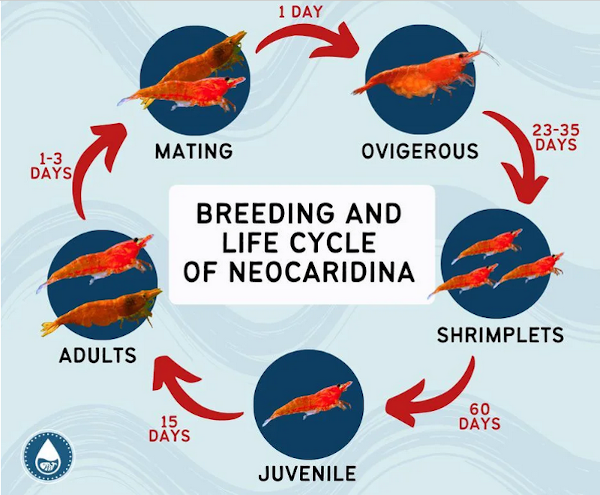
- The Neocaridina breeding cycle is straighforward and happens continuously in freshwater
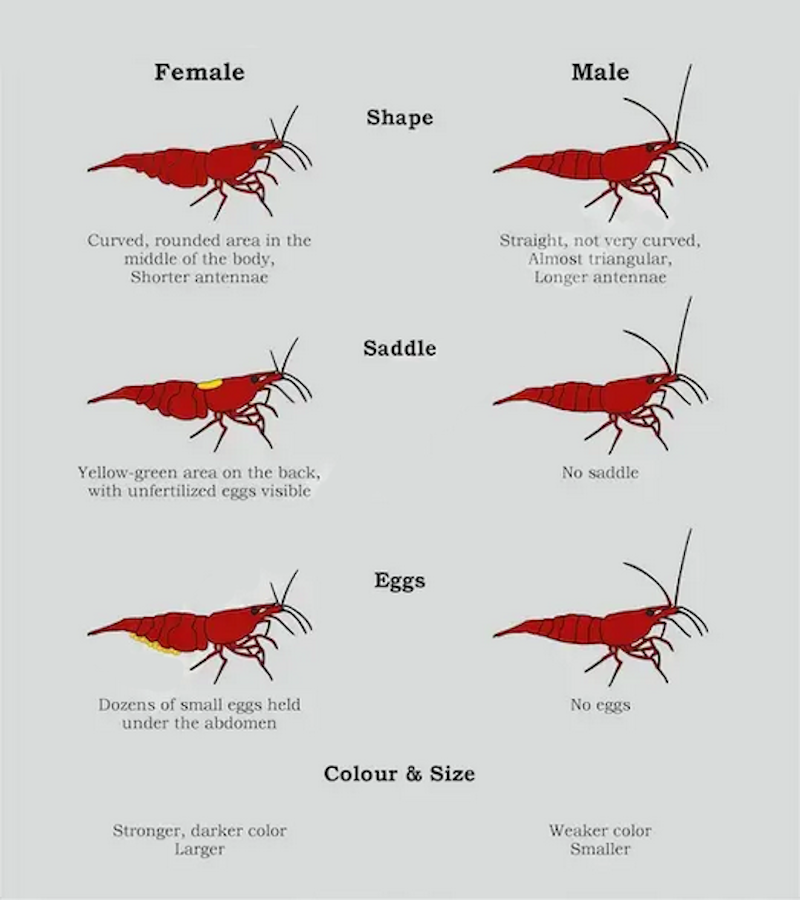
- Female shrimp develop unfertilized eggs in their "saddles," molt, release pheremones to attract males, then mate
- They carry fertilized "berries" for 20 to 30 days before hatching minature, self-sufficient shrimplets
- The complete cycle from egg to mature adult capable of reproducing takes 4 to 6 months
- The Saddle Stage (1 to 2 weeks)
- As a female matures, she develops unfertilized eggs in her ovaries, visible as a saddle-shaped patch behind her head, on her back/topside
- The color of the saddle varies (yellow, orange, green) depending on the Neocaridina variant
- Molting and Mating
- Because a female's exoskeleton hardens after a molt, she must shed her old shell to become receptive to male insemination
- Once molted, she releases potent pheremones into the water, signaling that she is ready to mate, causing males to actively search for her
- Mating occurs within minutes and is extremely fast (taking only 5 to 15 seconds), one male will fertilize the eggs
- Egg-Carrying/Berried/Ovigerous Stage (20 to 30 days)
- Within a few hours of mating, the female passes the eggs through the deposited sperm to become fertilized (external fertilization) and attaches them to her swimming legs (pleopods) under her abdomen
- The female will hold the fertilized eggs under her abdomen for the duration of their development to shrimplets ready to hatch, about 30 days
- This phase is referred to as being "berried" because the fertilized eggs resemble a cluster of berries
- She will constantly fan fresh, oxygenated water, with her swimmerets, over the eggs in the brood pouch (formed by the pleopods) to keep them free of debris and fungus
- Occasionally, the female will drop the eggs for no apparent reason, probably stress related, conditions not right for breeding, and that brood is terminated
- Hatching and Shrimplet Stage (about 2 months)
- After 3 to 4 weeks, the eggs hatch into tiny, clear (transparent) miniature versions of adult shrimp (2 mm long)
- There is no larval stage
- The mother provides no parental care, shrimplets are on their own after hatching
- The shrimplets immediately latch onto plants or rocks to hide and graze on naturally occurring biofilm and algae
- Juveniles and Maturity (2 to 6 months)
- For the first few weeks, shrimplets are highly vulnerable and spend most of their time in hiding
- As they eat and grow, they molt frequently to expand their bodies
- By 2 months, they transition into juveniles and begin to show their adult coloration
- At 4 to 6 months they reach adulthood and can begin breeding themselves, restarting the cycle
Sexing Neocaridina Davidi Shrimp